God of the Oppressed - Cone by James Cone
Author:James Cone
Language: eng
Format: epub
Should tyrants take it into their heads to emancipate any of you, remember that your freedom is your natural right. You are men, as well as they, and instead of returning thanks to them for your freedom, return it to the Holy Ghost, who is your rightful owner. If they do not want to part with your labors,... and my word for it, that God Almighty will break their strong band.2
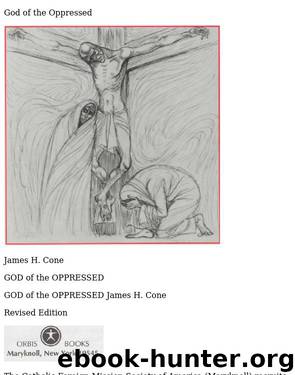
The grounding of liberation in God’s act in Jesus Christ is the logical consequence of any Christian theology that takes Scripture seriously as an important source for the doing of theology. According to Scripture, the human freedom to hope for a new heaven and a new earth is grounded in God’s freedom. Divine freedom is not merely an affirmation of the self-existence and complete transcendence of God over creaturely existence. It also expresses God’s will to be in relation to creatures in the social context of their striving for the fulfillment of humanity. That is, God is free to be for us. This is the meaning of the Exodus and the Incarnation. The biblical God is the God whose salvation is liberation. God is the God of Jesus Christ who calls the helpless and weak into a newly created existence. God not only fights for them but takes their humiliated condition upon the divine Person and thereby breaks open a new future for the poor, different from their past and present miseries. Here is the central meaning of the cross, dramatically revealed in the Markan account of Jesus’ cry of dereliction: “My God, my God, why hast thou forsaken me?” (15:34). These words show the depth of Jesus’ agony and the pain of being abandoned by his Father. But because he was one with divinity and humanity, the pain of the cross was God suffering for and with us so that our humanity can be liberated for freedom in the divine struggle against oppression. This is why Ernst Kasemann says that “Jesus means freedom,” and why Moltmann is correct in his contention that “the Christian faith not only believes in freedom but is already freedom itself. It not only hopes for freedom but, rather, is itself the inauguration of a free life on earth.”3
When God is revealed in history as freedom for us, he is disclosed as the God of hope. “Christian theology,” writes Moltmann, “speaks of history eschatologically.”4 To speak of history eschatologically is to speak of the promise of God’s Word of liberation, disclosed in God’s future, breaking into our present, and overthrowing the powers of evil that hold people in captivity. This theme is prominent in the black religious tradition with its claim that Jesus has not left black people alone in suffering. He is not only with them, “buildin’ them up where they are torn down and proppin’ them up on every leanin’ side,” but he is also “coming on the clouds of heaven” to take them “home to glory.” Black people’s faith in Jesus’ future
Download
This site does not store any files on its server. We only index and link to content provided by other sites. Please contact the content providers to delete copyright contents if any and email us, we'll remove relevant links or contents immediately.
The Lost Art of Listening by Michael P. Nichols(7554)
Why I Am Not A Calvinist by Dr. Peter S. Ruckman(4188)
The Rosicrucians by Christopher McIntosh(3549)
Wicca: a guide for the solitary practitioner by Scott Cunningham(3214)
Signature in the Cell: DNA and the Evidence for Intelligent Design by Stephen C. Meyer(3185)
Real Sex by Lauren F. Winner(3061)
The Holy Spirit by Billy Graham(3000)
To Light a Sacred Flame by Silver RavenWolf(2866)
The End of Faith by Sam Harris(2773)
The Gnostic Gospels by Pagels Elaine(2564)
Waking Up by Sam Harris(2494)
Jesus by Paul Johnson(2408)
Nine Parts of Desire by Geraldine Brooks(2404)
Devil, The by Almond Philip C(2372)
The God delusion by Richard Dawkins(2341)
Heavens on Earth by Michael Shermer(2312)
Kundalini by Gopi Krishna(2221)
Chosen by God by R. C. Sproul(2202)
The Nature of Consciousness by Rupert Spira(2141)
